01—Services
Mechanical Design
I have worked in mechanical design since 2008. That remains the base of almost everything I do today.
From concept to production-ready CAD
I have worked in mechanical design since 2008. That remains the base of almost everything I do today.
For me a good design is not only geometrically correct. It also has to be built up logically, stay manufacturable, and be clear enough that production can continue from it. That holds for a simple welded construction as much as for a full installation with machines, platforms, tanks, piping and maintenance access.
I work a lot in Autodesk Inventor, but the software is not the starting point. First the product has to be right.
What I design
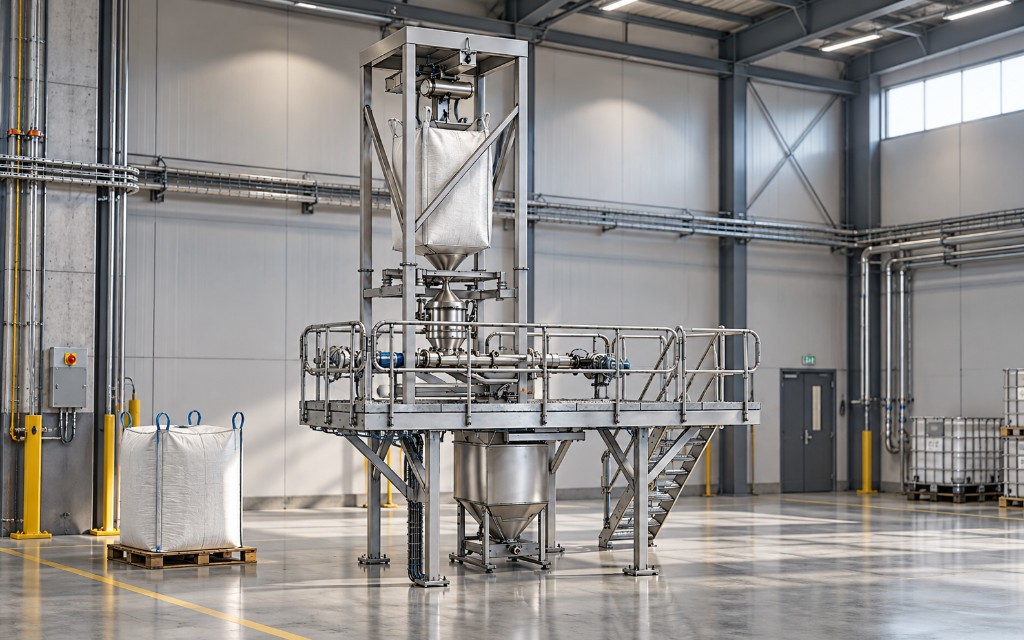
My work sits mainly in machine building, steel and stainless constructions, sheet metal and technical products with a lot of connection between parts. Think of frames and profiles, platforms and stairs, commercial-kitchen equipment, machines, process installations and configurable assemblies.
On larger installations I do not only look at individual parts. Layout, accessibility, assembly, maintenance and the way subsystems come together matter at least as much.
Parametric where it makes sense
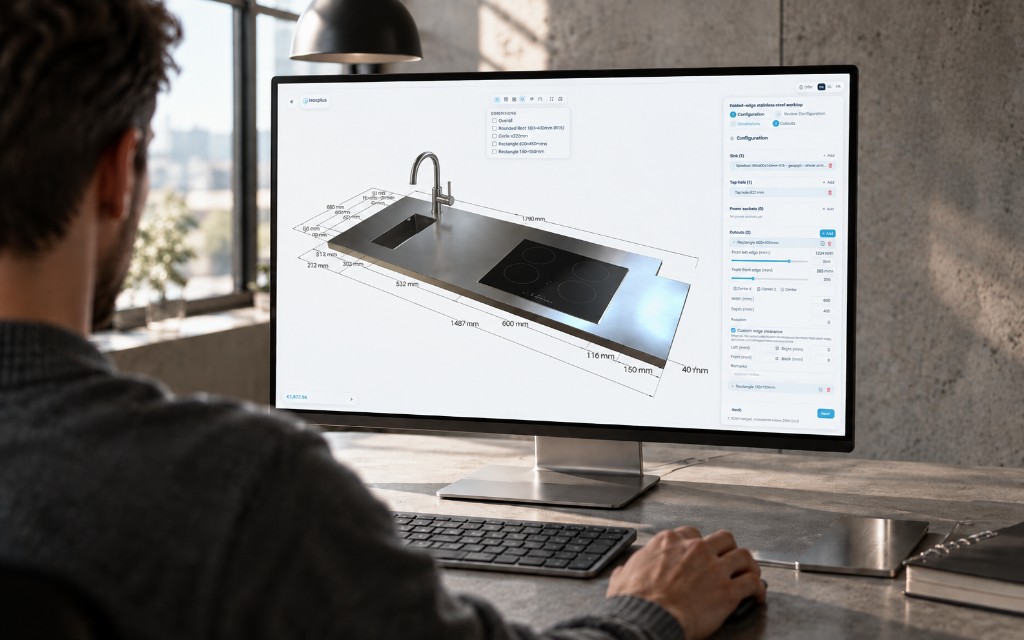
I like to build models so that logical variation can also be managed logically.
Not every part has to be parametric or smart. But when a machine family has returning dimensions, options or modules, it pays to take that into account from the start. That makes a model faster to adapt, and later also a better base for automation or configuration.
That is the connection to my other work. A solid CAD model can later grow into iLogic, engineering automation or a full product configurator, without everything having to be rebuilt.
Production output belongs with it
A design is only usable if the next step can continue from it.
That is why production drawings, bills of materials, sheet-metal details, profile information and other production output belong with the engineering. I try to build models so that this information comes as directly as possible from the design, instead of being assembled again afterwards.
When I fit best
I am most useful on assignments that need more than drawing. When a design still has to take shape, many parts come together, or parametric thinking and later automation already matter early, I can usually add more value than when everything is already fully fixed.
I can take on the complete mechanical design, or join an existing engineering team for a defined part of a machine or installation. Have you got a mechanical design that still has to be worked out, or an existing product that is becoming hard to manage because of variants? Send me some context.
02—Selected