Ideas
Openframe
Openframe started with a simple question: how far can you get at home with FDM when a bicycle frame is designed around that manufacturing process instead of trying to copy a conventional metal frame?
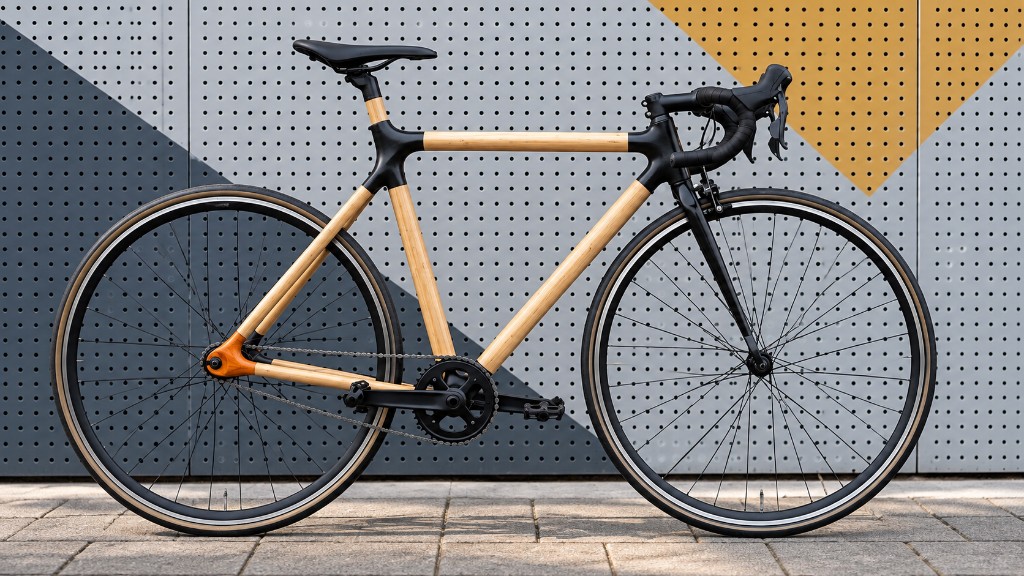
Building it changed the question. Not everything needs to be printed. The more interesting problem is which parts benefit from the geometric freedom of FDM, which materials are better suited to other tasks, and how loads should travel through the complete frame.
The latest documented version, v0.2, combines bamboo veneer tubes with 3D-printed PA12-CF lugs.
From a printing question to a structural one
At first glance, a bicycle frame looks like a set of tubes between a number of fixed points. In reality, those parts have to carry pedalling, steering, braking and road loads while the frame remains light, stiff and accurately aligned.
FDM adds its own constraints. Strength is directional, print volume is limited, and the joints between separate parts become an essential part of the design.
Openframe therefore quickly became less a question about 3D printing itself and more a structural question: where should material sit, how should loads travel through the frame, and which manufacturing process makes sense for each part?
A hybrid frame
V0.2 combines bamboo veneer tubes with printed lugs around areas such as the head tube, bottom bracket, seat cluster and dropouts.
That split is deliberate. The tubes provide the long structural connections, while the printed parts can handle complex geometry, angles and interfaces.
FDM is therefore not the goal in itself. It becomes a manufacturing process used where its geometric freedom actually adds value.
Parametric instead of one frame
The frame is built parametrically in Autodesk Inventor. Dimensions and geometric relationships can change without modelling every lug again from scratch.
That makes Openframe more interesting than one fixed bicycle. The same logic can let frame geometry, tube lengths and interfaces change together in a controlled way.
The eventual idea is therefore broader than a set of STL files: a configurable frame system where geometry and parts are generated from the same underlying relationships.
V0.2 exposed the real problems
With v0.2, the project became a fully assembled and rideable prototype for the first time.
That immediately produced new design information. The dropouts needed to become more robust, the seat cluster needed more stiffness, and several bonded joints could be made deeper and more precise. Print orientation, tolerances and load direction also turned out to be tightly connected.
The first controlled rides were useful because they showed that the concept could function as a complete system. They are explicitly not evidence of fatigue life or safety for normal road use.
Testing is part of the design
When the prototype was shared publicly, it attracted useful technical criticism around the combination of FDM, nylon composite and bamboo.
Questions about layer bonding, creep, fatigue, impact and possible sudden failure modes are not things to solve afterwards. They belong inside the design and test process.
The focus therefore shifts from “can I make this?” toward “how can I demonstrate what this part can take, where it fails, and how to improve it in a controlled way?”
A second direction: indoor trainers
One of the most interesting follow-up directions is a frame specifically for indoor smart trainers.
Real pedalling loads, ergonomics, joints and stiffness still matter, while much of the unpredictability of traffic and road use disappears. That makes the environment much more suitable for controlled testing of new structures.
Within Openframe, that direction became known as Kanibaal.
Open development
Openframe is set up as an open engineering project. The aim is to keep design decisions, prototypes, failures and test results visible, and eventually make useful files, a bill of materials and build information available as well.
The durable technical material is now also being brought into Kubuz as separate notes and references. The original Openframe site remains available for now as the chronological project archive.
The frame is experimental and is not certified to a bicycle safety standard. It is not a product for use on public roads.