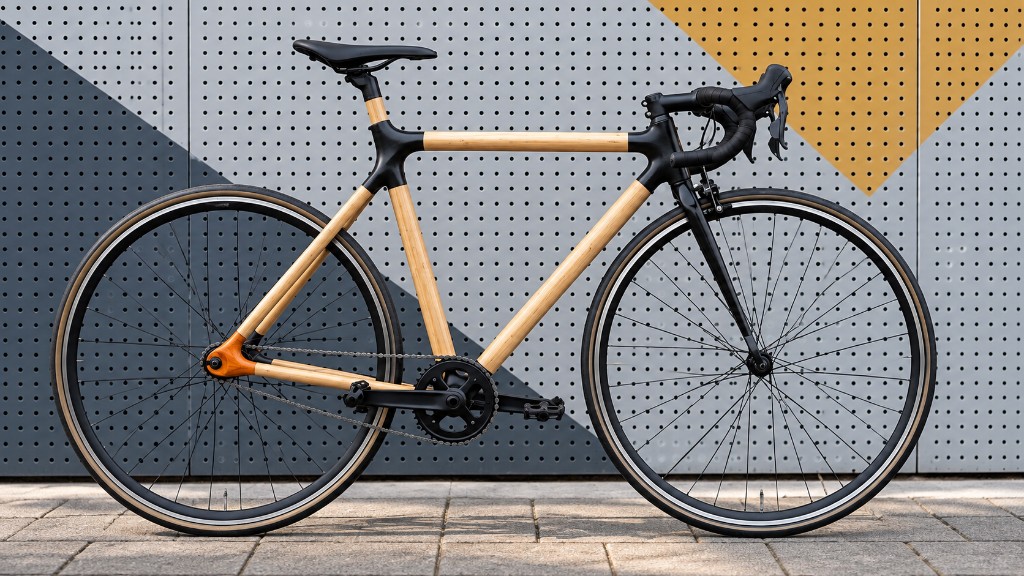
That immediately exposed problems that remain easy to hide in CAD.
What assembly revealed
During assembly it became clear that the joints and interfaces needed the most attention.
The rear dropouts needed to become more robust and the rear wheel needed better positioning for chain tension. The seat cluster needed more stiffness. The bottom-bracket connection needed to become stronger and more precise, and several bonded joints could use more insertion depth to increase their bonding area.
Tolerances also turned out to matter more than they appear to on screen. A small difference in fit affects not only the adhesive layer, but also how easily the complete frame can be aligned correctly.
From CAD model to physical system
An interesting consequence was that several design decisions had to be traded against each other again.
Thicker walls can make a lug stiffer, but increase weight and print time. A larger interface creates more bonding area, but changes the shape and assembly. A different print orientation may improve the relationship between load and layer direction, while making support or surface quality harder.
That is exactly why I wanted to build the project physically. The optimum does not sit in one parameter; it is a continuous compromise between structure, manufacturing and use.
The first controlled tests
In November 2025, v0.2 was ridden carefully for the first time in controlled conditions. The devlog at the time recorded roughly 10 km of early testing across asphalt, cobblestones and a few rougher sections.
At that point no visible problems had been reported in the printed lugs, and the frame felt stiffer than expected. That was encouraging, but it says very little about fatigue life or ultimate safety.
I therefore treat that ride as a prototype milestone, not as validation for normal road use.
Feedback as new design input
When v0.2 was shared publicly it attracted a large amount of technical feedback. The main questions concerned layer bonding and print orientation, creep and fatigue in nylon composites, failure modes in the lugs and the need for much more systematic testing.
There were useful suggestions as well: test individual joints separately, add mechanical inserts, reinforce critical areas, build up static and cyclic loading, and eventually test against principles used in bicycle standards.
Not every suggestion automatically becomes a design decision. Together, however, they form a useful list of assumptions the project still has to prove or disprove.
A safer direction for experimentation
The discussion also reinforced the idea of a frame designed specifically for an indoor smart trainer.
That does not remove the engineering problem, but it removes part of the unpredictability of traffic and road use. Real pedalling loads, ergonomics, joints and stiffness can still be explored in a much more controllable environment.
Within the project, that direction became known as Kanibaal.
What v0.2 actually proved
V0.2 did not prove that an FDM/bamboo bicycle frame is safe.
It proved something else that was at least as useful for the project: the concept could be taken far enough for the real engineering questions to become visible.
From that point on, Openframe became less about whether it could look like a bicycle and much more about making joints dependable, understanding load paths, building meaningful tests and developing a configurable frame system.